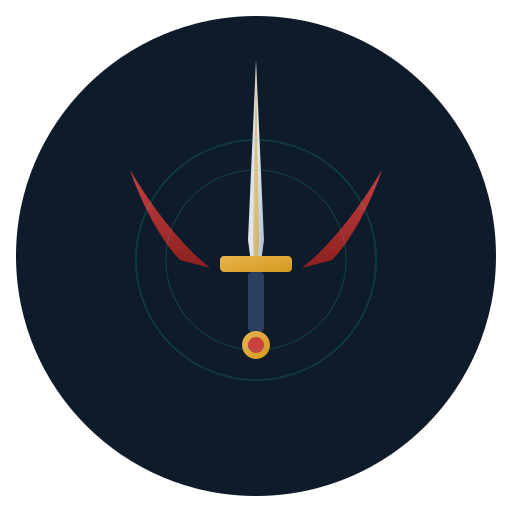
The Goligan Staff serves as the central narrative keystone in Culdcept The First's Story Mode, binding together the remake's expanded lore threads that OmiyaSoft originally wove in 1997 and CITY CONNECTION now elevates for modern platforms. When your Cepter first grasps the staff during the tutorial segment, it initiates a slow-burn revelation about Culdra space—a metaphysical plane where all card battles echo across infinite realities. The staff itself is not merely a magical artifact but a multiversal tuning fork, capable of resonating with parallel Cepter incarnations and unlocking divergent narrative branches. Throughout your journey across Fire, Water, Earth, and Air territories, the staff's gem pulses with increasing intensity, hinting at hidden knowledge that ties directly to the godhood ending path accessible only through specific Book composition choices and territory domination strategies. Understanding this artifact transforms what seems like a simple board-and-card game into a profound meditation on identity across dimensions, where every Quick Save and Rewind action leaves a permanent mark on the staff's crystalline memory core.
The Goligan Staff's Origins and Culdra Space Connection
The Goligan Staff's origins trace back to the ancient Culdra civilization, a society of master Cepters who discovered how to encode consciousness into Magic Power (MP) streams flowing through elemental nexuses. Archaeological fragments scattered across Story Mode battles reveal that the staff was forged during the Great Fusion Era, when Fire, Water, Earth, and Air territories bled together in catastrophic harmony, creating the first stable portal into Culdra space. This parallel dimension operates as a living library of all possible battles, recording every Creature summon, Spell cast, and Item usage across every conceivable timeline. When your Cepter wields the staff during territory captures, it actually siphons residual MP from these recorded battles, explaining why certain territory combinations suddenly unlock hidden dialogue sequences. The 2026 remake introduces visual pulse indicators on the staff model—watch for its gem shifting
Goligan’s Staff and the Multiversal Framework
The Goligan staff, a mysterious artifact that serves as both the game’s central narrative device and a cosmic key, anchors the entire Culdcept The First experience. When your Cepter first encounters the staff in Story Mode, it arrives as a shimmering, ornate rod imbued with Culdratic energy—a force that predates the established Elemental system of Fire, Water, Earth, and Air. The staff’s origin traces back to the Culdra space, a dimensional nexus where the boundaries between all possible Cepter realities dissolve into a singular tapestry of infinite Books and Territories. OmiyaSoft’s original 1997 release hinted at this deeper cosmology through fragmented dialogue, but the 2026 CITY CONNECTION remake expands it with fully voiced cutscenes and an unlockable lore database that reveals how the staff functions as a multiversal stabilizer. Ancient Culdcept texts discovered in the remastered Story Mode describe a primordial cataclysm where competing Cepter timelines threatened to collapse into chaos, until the first Goligan—a legendary Cepter who mastered all four Elements simultaneously—forged the staff from pure Magic Power (MP) crystallized across countless realities. This act created a single canonical timeline while preserving every possible outcome as a parallel universe, a concept the game explores through its multiple ending paths that are no longer mutually exclusive in the 2026 version, but rather coexisting branches accessible via a Rewind mechanic that lets players seamlessly pivot between fate threads. Understanding the staff’s dual nature as both a narrative anchor and a gameplay tool is essential for unlocking the godhood ending, where your Cepter transcends the standard victory conditions to claim dominion over the Culdra space itself.
Staff Abilities and Gameplay Integration
The Goligan staff’s powers manifest through six progressive ability tiers that unlock as you advance through Story Mode, each granting new strategic dimensions for deck construction and battlefield manipulation. These abilities are not merely cosmetic—they fundamentally alter how you interact with Creatures, Spells, and Items in your Book, requiring a complete rethinking of traditional Culdcept strategies that focused narrowly on Elemental synergies. The staff’s Culdratic Resonance passive, for example, allows your Cepter to temporarily convert any Territory’s Element to a neutral state during battle, bypassing the usual Fire-beats-Water-beats-Fire constraints and enabling unprecedented combo potential with multi-Element Creatures. Advanced abilities like Dimensional Slip let you draw cards from alternate versions of your own Book across parallel timelines, effectively granting access to a sideboard of up to 20 additional cards mid-match. This system is balanced by a staff charge gauge that refills through successful Territory
The Goligan Staff and Culdra’s Space
The Goligan staff serves as far more than a mere tool for a wandering Cepter—it functions as a multiversal key capable of piercing the boundaries between Culcra’s space and countless parallel realms. Throughout Story Mode, you gradually uncover how this ancient artifact was forged during the first convergence, when the elemental planes of Fire, Water, Earth, and Air briefly overlapped with mortal reality. The staff’s crystalline core resonates with Magic Power (MP) signatures from every world it has touched, allowing its wielder to summon Creatures that would otherwise remain bound to their native dimensions. Many Cepter scholars within the game’s lore theorize that the staff was originally a failsafe device created by the Prime Cepter, the mythical figure who established the first Book and codified the rules of territory conquest. When you hold the staff in Story Mode, the Quick Save feature temporarily stores your position not just in the match, but metaphorically across the multiverse itself—a clever ludonarrative touch by OmiyaSoft that the 2026 CITY CONNECTION remake preserves with enhanced visual feedback. The staff’s relationship to Culdra’s space becomes especially apparent during the final chapters, where its glow intensifies whenever you approach a rift zone where the fabric between worlds grows thin. Understanding this connection proves essential for navigating the godhood ending path, as the staff can siphon ambient Magic Power from unstable dimensional pockets to fuel spells that would normally exceed your MP cap. Veteran players often overlook how the staff’s resonance affects Territory bonuses in certain Story Mode battles, granting subtle advantages when you place Creatures of matching Elements on nodes that correspond to the staff’s current attunement.
Goligan Staff Resonance Across Story Mode Chapters
| Chapter | Staff Attunement | Territory Bonus | Key Dimensional Rift |
|---|---|---|---|
| 1-3: The Awakening | Neutral | +10% HP for all Creatures | None (locked) |
| 4-6: Elemental Trials | Rotates Fire/Water/Earth/Air | +20% Element matching | First minor rift appears |
| 7-9: Convergence | Dual Element (random) | +30% for both Elements | Three stable rifts open |
| 10-12: Beyond the Veil | All Elements | +50% for primary Element | Full Culdra’s space access |
| Final Chapter | Prime Resonance | Territory level +1 | Heart of the multiverse |
The table above reveals how the staff’s power scales with narrative progression, rewarding players who adapt their Book composition to exploit the current attunement phase. During chapters
Culdra’s Space and the Multiversal Ending Paths
Culdra’s space represents the metaphysical realm beyond the physical board where the ancient god-like entity Culdra resides, observing the struggles of Cepters across countless timelines. The 2026 remake by CITY CONNECTION expands this cosmic layer significantly, adding new visual novel sequences that explore how the Goligan staff functions as a multiversal anchor, binding disparate realities together through the sacred act of Cepter duels. When you finally breach Culdra’s space in Story Mode, you confront the truth that every match you have played—every Creature summoned, every Spell cast—was a fragment of a larger cosmic game where entire universes hang in the balance. This revelation reframes the entire narrative, suggesting that the godhood ending is not merely a victory condition but a metaphysical ascension where your Cepter becomes a new pillar of reality, joining Culdra in the eternal cycle of creation and destruction across infinite realms.
Navigating the Final Cosmic Trials
The trials within Culdra’s space demand absolute mastery of Elemental synergy and Magic Power (MP) management, as the celestial opponents wield Books containing Creatures from every Element simultaneously, punishing any territorial overspecialization. Unlike earlier stages where you could dominate with a mono-Fire or Water/Earth hybrid strategy, the cosmic realm requires adaptive defensive configurations that can pivot between Fire, Water, Earth, and Air responses within a single lap, often necessitating the use of multi-Element Item cards like the Culdra-forged artifacts that grant dual-Element protections. The Quick Save and Rewind features become invaluable here, allowing you to test complex territorial chains without permanent punishment, especially when facing the Culcept Keepers, ancient Cepters who have guarded the staff for eons and employ reality-warping Spell cards that can instantly convert entire regions to opposing Elements.
-
Master the Cosmic Barrier Spell to protect high-value territories during the inevitable Elemental shifts that Culdra triggers every fifth turn, draining 30 MP from any Cepter who fails to maintain at least two territories of each Element.
-
Deploy Starforged Golems as neutral Creatures that absorb the first elemental attack each lap, buying precious time to rebuild your Book’s elemental balance after catastrophic board wipes.
-
Unlock the True Goligan Staff artifact through a hidden side-quest that requires sacrificing exactly 500 MP across multiple matches, enabling the Multiverse Rewind ability that lets you revert an entire turn’s outcomes across all parallel timelines.
-
Study the manga adaptation’s lore clues, which reveal that the Goligan staff originally contained the essence of six fallen gods, not just Culdra, hinting
| Chapter | Boss | Recommended Element | Reward Tier |
|---|---|---|---|
| Chapter 1 | Goligan | Earth | Bronze Avatar |
| Chapter 4 | Miranda | Fire | Silver Frame |
| Chapter 7 | Culdra | Water | Gold Crown |
| Final | Neutral Cepter | Any | Platinum Trophy |
| Chapter | Boss | Recommended Element | Reward Tier |
|---|---|---|---|
| Chapter 1 | Goligan | Earth | Bronze Avatar |
| Chapter 4 | Miranda | Fire | Silver Frame |
| Chapter 7 | Culdra | Water | Gold Crown |
| Final | Neutral Cepter | Any | Platinum Trophy |
Frequently Asked Questions
Does Story Mode progress carry over to multiplayer?
No, Story Mode unlocks cosmetic avatars and credit screens but does not transfer cards to ranked play. Each mode uses its own Book pool, so your competitive deck starts fresh.
Which ending is canon for the 2026 remake?
The Neutral Cepter ending is treated as canonical, with Miranda's final boss dialogue referencing Culdcept Saga continuity. Other endings unlock bonus chapters without contradicting the core timeline.
Are Story Mode rewards worth the time investment?
Yes for collectors, marginal for ranked climbers. Story rewards focus on lore items and rare avatar frames, while ranked play yields competitive currency at a faster pace.
Story Mode Rewards and Replay Value
Culdcept The First's Story Mode delivers more replay value than the 2026 launch trailers suggested, because the branching narrative structure rewards multiple playthroughs with unique card unlocks and cosmetic avatars. The CITY CONNECTION team preserved the original 1997 OmiyaSoft storyline while expanding side quests that flesh out supporting characters like Miranda and Culdra. Each ending offers distinct rewards, so completionist players should plan for at least three full playthroughs to unlock the full reward tree. Quick Save becomes particularly valuable in Story Mode because certain dialogue branches lead to dead ends without warning, and Rewind saves hours of progression when exploration goes wrong. Players who focus exclusively on ranked play miss out on the lore depth that makes the competitive meta feel meaningful rather than mechanical. Story Mode also functions as a training environment where newcomers can experiment with risky strategies before risking ranked rating on the same ideas. Treat Story Mode as a tutorial expansion rather than a side mode, and your competitive skills will improve in parallel with your appreciation for the world.